Fistula treatment without surgery is one of the most common questions we hear from patients who have been told they have a bhagandar (fistula in ano). It is natural to hope that tablets, creams or a home remedy will be enough. The honest answer is that for most fistulas, medicines alone cannot close the problem, but today's procedures are often smaller, and recovery quicker, than many people fear. Knowing the facts early can save you from years of discharge, pain and repeated abscesses.
What is a fistula (bhagandar)?
An anal fistula is a small tunnel that runs from inside the back passage to an opening on the skin near the anus. It usually starts as an abscess (a collection of pus) in a small gland inside the anus. When the abscess bursts or is drained, a tunnel can remain behind. Common signs are:
- A small opening near the anus that keeps leaking pus, blood or watery discharge
- Staining of underwear, itching and irritation of the skin
- Pain and swelling that build up, then ease when pus drains, again and again
- Fever when a new abscess forms
A fistula is different from piles and fissure, although people often mix them up. Our guide to the difference between piles, fissure and fistula explains how.
Is fistula treatment without surgery possible?
For most anal fistulas, the honest answer is no. The tunnel develops its own lining, and once that lining forms, it rarely closes by itself. Trusted health services such as the NHS in the UK note that anal fistulas usually do not get better on their own and that a procedure is needed in most cases.
There are some situations where medicines play a larger role:
- Crohn's disease (a long-term inflammation of the bowel) can cause fistulas that need medical treatment for the disease, often together with a procedure such as a seton.
- Tuberculosis can occasionally cause a fistula. In that case a full course of TB medicines is essential, and the tissue test after a procedure helps to find it.
- A person who is too unwell for anaesthesia may be managed with medicines and dressings for a time.
These are exceptions, and we decide them only after a proper examination, not by guesswork.
Fistula treatment tablets: what medicines can and cannot do
Medicines can:
- Calm an active infection and reduce swelling and pus for a while (antibiotics)
- Relieve pain
- Soften stools so that passing stool hurts less
- Control conditions that slow healing, such as diabetes
Medicines cannot close the tunnel. That is why many people feel better on tablets, only for the discharge and swelling to return weeks later. Taking antibiotics again and again without a plan can hide the problem while the fistula slowly becomes more complex.
Why delaying treatment is risky
- Repeated abscesses, each one painful and sometimes with fever
- New branches of the tunnel, turning a simple fistula into a complex one
- A more complex fistula means a bigger procedure and a higher risk to the sphincter, the ring of muscle that controls stool
- In people with diabetes, infection around the anus can spread quickly and become serious
Be careful with unqualified treatment
Some people try threads, pastes, powders or chemicals applied by someone without proper medical qualification. Strong chemicals can burn the skin and the muscles around the anus, leading to scarring, narrowing or loss of control over stool. Untrained treatment can also miss an underlying disease such as Crohn's disease or TB. Whoever treats you, please check their qualification and ask exactly what will be done.
Laser treatment for fistula and other minimally invasive options
A procedure does not always mean a big operation. The method depends on how the tunnel runs in relation to the sphincter muscles. For complex fistulas, an MRI scan may be advised first to map the tunnel.
Laser fistula closure (FiLaC)
A thin laser fibre is passed into the tunnel, and the lining is sealed from inside. It is used for selected fistulas, especially some high or complex ones where protecting the sphincter matters most. Wounds are small and recovery is often quicker. It does not close every fistula, and some patients need a repeat procedure or another method.
Seton
A seton is a soft surgical thread placed through the tunnel for some weeks. It lets pus drain, calms the infection and protects the muscle. It is often a first step before a final procedure.
Fistulotomy or fistulectomy
For simple, low fistulas that involve little muscle, the tunnel is opened (fistulotomy) or removed (fistulectomy) and left to heal from the inside. For suitable fistulas this is a reliable method with a good chance of healing.
At Dr. R.K. Thakur Hospital, Gopalganj, we use the diode laser, seton and conventional methods, and we choose the method that suits your fistula after examination. You can learn more on our page on fistula surgery and laser treatment.
What recovery looks like
Most patients stay 1 to 2 days. Warm sitz baths 2 to 3 times a day and after every stool, dressings as taught, stool softeners and a fibre-rich diet all help healing. Most people return to light work in 1 to 2 weeks. An open wound often takes about 4 to 6 weeks to heal, and larger ones longer; wounds after laser closure are smaller. A fistula can come back after any method, so please keep every follow-up visit until our surgeon confirms full healing.
If you have a painful swelling right now
A hot, painful, swollen lump near the anus, often with fever, is usually an abscess. Antibiotics alone do not cure an abscess; the pus needs to be drained. Please do not wait for it to burst. You can read more on our page on abscess drainage.
When to see a doctor
- A small opening near the anus that keeps discharging pus or blood
- Painful swelling near the anus, with or without fever
- A fistula that has come back after earlier treatment
- Diarrhoea, weight loss or belly pain along with a fistula, which can point to Crohn's disease
- Please come to our emergency straight away for high fever, spreading redness, severe pain or feeling very unwell, especially if you have diabetes.
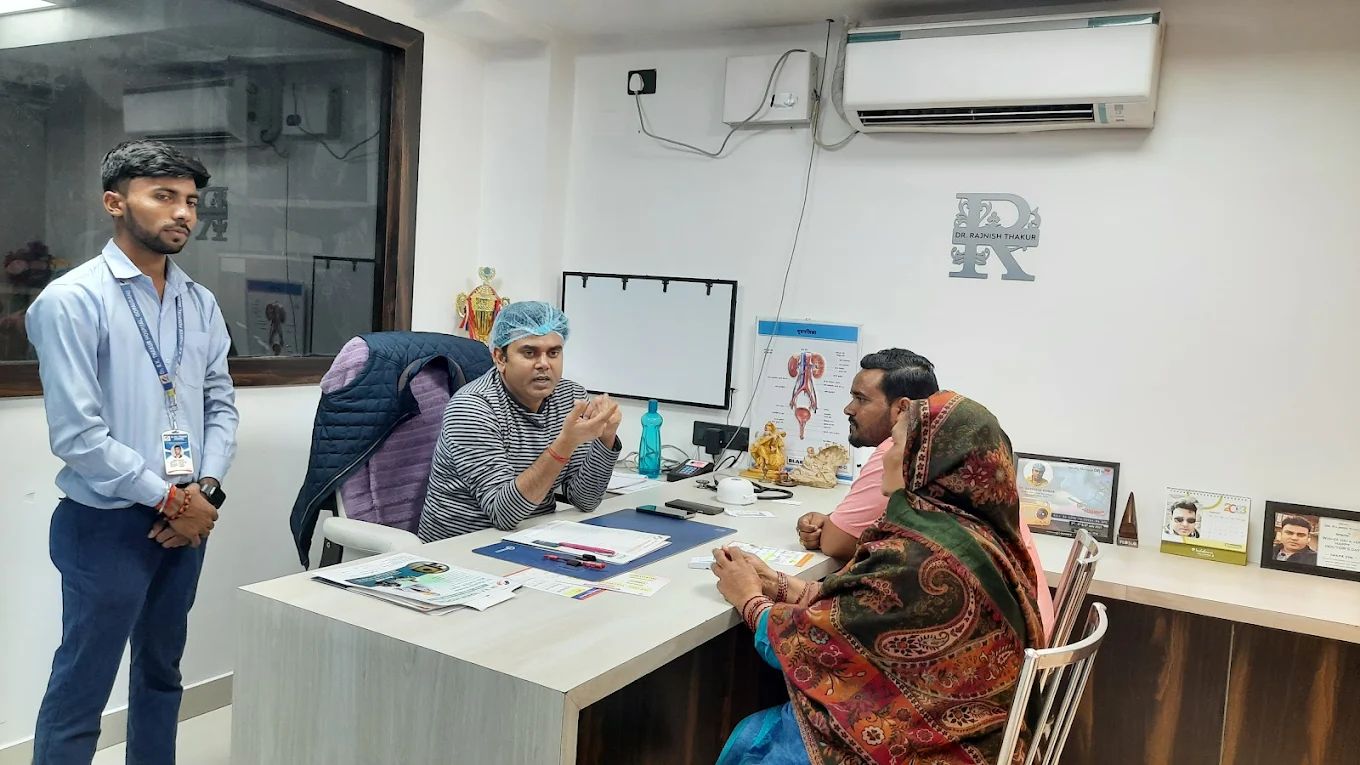
A fistula can feel embarrassing to talk about, but it is a common condition, and there is no need to feel shy with us. At Dr. R.K. Thakur Hospital, Gopalganj, Dr. Rajnish Kumar Thakur, our founder and chief surgeon, is a Laparoscopic, Laser, Urology and General Surgeon with 16+ years of experience. He examines every patient in private and explains each option, including whether a smaller procedure suits you. You can read about the full range of care in our piles, fissure and fistula department. Ayushman Bharat card holders can ask our Ayushman help desk whether their treatment is covered. Please call or WhatsApp us on +91 72739 94786 to book your OPD visit.