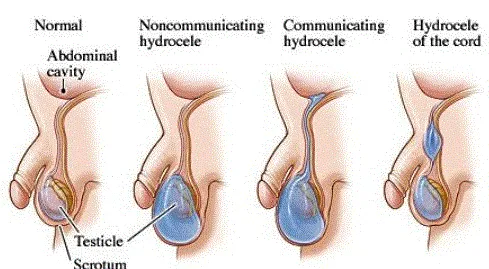
A hydrocele is a collection of fluid around the testis, inside the scrotum (the skin bag that holds the testes). It shows up as a slowly growing swelling on one or both sides. It is common in men of all ages in Bihar and eastern Uttar Pradesh, yet many men hide it for years because of shyness or wrong beliefs. Here our surgical team clears up common hydrocele myths with plain facts.
Here are the most common myths, and the facts behind them.
What causes a hydrocele?
Each testis has a thin covering that normally holds a tiny amount of fluid. When more fluid is made, or less is absorbed, it collects and the swelling grows. In adults the exact cause is often not known. Known causes include:
- Filaria, a mosquito-borne infection that can also cause swelling of the legs, and which is common in parts of Bihar and eastern UP
- Injury to the scrotum
- Infection or inflammation of the testis
- In babies, a small opening between the belly and the scrotum that has not closed after birth
Rarely, a hydrocele appears along with a problem in the testis itself, which is why an ultrasound is often advised.
Myth 1: "Taking the water out with a needle cures it"
Fact: Drawing out the fluid with a needle (tapping) gives relief only for a short time. In most cases the fluid collects again within weeks or months, because the covering that makes the fluid is still there. Repeated tapping also carries a risk of infection and bleeding inside the scrotum, and it can make a later operation more difficult. Tapping may be used in special situations, such as for a patient who is not fit for surgery, but it is not a cure for most men.
Myth 2: "Hydrocele destroys manhood"
Fact: In most cases a hydrocele does not affect a man's sexual ability or his ability to father children. The fluid lies around the testis, not inside it. A very large hydrocele can, however, cause heaviness, discomfort while walking or sitting, embarrassment and difficulty during intercourse. That is a good reason to treat it, not a reason to fear it. If you are worried about fertility, please tell our doctor, who can check the testes on ultrasound.
Myth 3: "It happens because of heavy work or bad habits"
Fact: A hydrocele is not caused by lifting weights, by sexual activity or by any "bad habit". There is nothing to be ashamed of. It is a medical condition like a stone or a hernia, and we see it regularly in our OPD.
Myth 4: "Oil massage, hot compresses or herbs will dissolve it"
Fact: No oil, massage or herbal medicine has been shown to remove a hydrocele. Rubbing the swelling or applying heat can harm the skin. For a troublesome hydrocele in adults, the reliable treatment is a small operation.
Myth 5: "Hydrocele and hernia are the same thing"
Fact: Both can cause swelling in the groin or scrotum, but they are different. A hernia is a bulge of intestine or fat through a weak spot in the belly wall, and it can get stuck, which is an emergency. A hydrocele is only fluid. A doctor can tell them apart by examination and ultrasound, and sometimes both are present together. You can read about hernia repair separately.
Myth 6: "The operation is big and risky"
Fact: Hydrocele surgery is a common and relatively simple operation. It is usually done under spinal or local anaesthesia through a small cut on the scrotum. The fluid is drained, and the covering is either removed or turned back so that fluid does not collect again. Most patients go home within 1 to 2 days.
Like any operation, it has some possible risks, such as swelling, a small collection of blood or infection. Recurrence after proper surgery is uncommon. Our surgeon explains these to you before the operation.
Myth 7: "It will go away if I wait"
Fact: In babies, a hydrocele often goes away on its own within the first year or two. In adults it usually does not go away and tends to grow slowly. A small hydrocele that causes no trouble can be watched, but a growing or troublesome one is best treated before it becomes very large.
Recovery after hydrocele surgery
- Wear a scrotal support or firm underwear for a few weeks.
- Some swelling and bruising is normal and settles over 2 to 4 weeks.
- Keep the wound clean and dry, and follow the advice on dressing and bathing.
- Most men return to light work in about a week and to heavy work in 2 to 3 weeks, as advised.
- Come for the follow-up and stitch check on the date given.
Protect yourself from filaria
Since filaria is one cause of hydrocele in our region, take the free filaria tablets given by government health workers during mass drug campaigns, and protect yourself from mosquito bites with nets and covered clothing.
When to see a doctor
- Any new swelling of the scrotum, to confirm what it is
- A swelling that is growing or making walking or work uncomfortable
- Sudden severe pain in a testis, with or without swelling. This can be twisting of the testis and needs emergency care within hours.
- Redness, fever or pain in an existing swelling
- A groin swelling that goes up and down, or becomes painful and hard
- A swelling in a child's scrotum that is still present after the age of 1 to 2 years, or that changes size during the day
At Dr. R.K. Thakur Hospital, we examine men from Gopalganj, Siwan, Chhapra and nearby districts for scrotal swelling, always in privacy. You can read more about our hydrocele surgery.
In our hospital, hydrocele surgery is performed by Dr. Rajnish Kumar Thakur, our founder and chief surgeon, a Laparoscopic, Laser, Urology and General Surgeon with 16+ years of experience. Please do not feel shy: we examine such swellings regularly, always in private. Ultrasound is available in our hospital. You can learn more about hydrocele repair. To book an OPD visit, please call or WhatsApp us on +91 72739 94786.