Hernia repair is one of the most common operations we perform at Dr. R.K. Thakur Hospital, Gopalganj. After a good repair, what you do in the next few weeks is very important, both for healing and for keeping the hernia from coming back. Knowing the usual hernia surgery recovery time, the precautions after hernia surgery that matter most and the warning signs to watch for helps you heal well and return to work safely. For your own case, the advice of our surgeon always comes first.
Hernia surgery recovery time: what to expect
Recovery depends on the type and size of the hernia, the method used and your general health. As a general guide:
- Groin (inguinal) hernia, laparoscopic repair: most patients walk and eat on the same day and go home in 1 to 2 days. Light work usually resumes in 1 to 2 weeks. Heavy lifting is avoided for about 4 to 6 weeks.
- Groin hernia, open repair: recovery is similar or a little slower, depending on the patient.
- Navel (umbilical) hernia: usually a stay of 1 to 2 days, light work in 1 to 2 weeks, and no heavy lifting for about 4 to 6 weeks.
- Hernia at an old operation scar (incisional hernia): usually a stay of 2 to 4 days, longer for very large hernias. Light work in 2 to 3 weeks, and no heavy lifting for about 6 to 8 weeks.
Most people feel close to normal in 2 to 4 weeks, but the repaired area keeps getting stronger for some months. That is why the lifting rules last longer than the pain does.
The first week at home
- Walk from day one. Short walks several times a day improve blood flow, lower the risk of clots in the legs and help the bowels move.
- Rest, but do not stay in bed all day.
- Take your medicines on time, including painkillers, as prescribed.
- Wound care: keep the dressing clean and dry, and bathe only when our team allows, usually after 2 to 3 days. Stitches that do not dissolve are usually removed in 7 to 10 days.
- Swelling and bruising in the groin, and in men sometimes in the scrotum, are common after groin hernia repair and settle over 1 to 2 weeks. A small soft swelling at the site, a fluid collection called a seroma, can also appear and usually goes away on its own. Please show it to us at your follow-up visit.
Precautions after hernia surgery
In Hindi these precautions are called परहेज. The main aim is to avoid sudden pressure on the repair while it heals.
1. Lifting weight after hernia surgery
For about 4 to 6 weeks, or 6 to 8 weeks after incisional hernia repair, do not lift anything heavy. In daily life this means no lifting of water buckets, gas cylinders, sacks of grain, bags of cement or a heavy child. Ask someone at home to help. After this period, start with lighter loads and increase slowly. Bend your knees, keep the load close to your body and do not twist while lifting.
2. Control cough
A strong cough pushes the wall of the abdomen outwards. If you have a cough, cold or asthma, please have it treated. When you cough or sneeze, press a small pillow or folded cloth firmly over the wound. Stop smoking, bidi and tobacco, which cause long-term cough and slow down healing.
3. Avoid constipation and straining
Straining in the toilet is one of the most common causes of pressure on a repair, and painkillers and less movement can make constipation worse. To prevent it:
- Drink plenty of water through the day.
- Eat fibre: dal, green vegetables, salad, fruits such as papaya and guava, and whole wheat roti or dalia.
- Walk every day.
- If stools are still hard, ask us about a mild laxative or isabgol. Do not strain.
Older men who strain to pass urine because of a prostate problem should tell our surgeon. This also puts pressure on the repair, and it can be treated.
4. Diet
There is no special diet after hernia surgery. Eat light, home-cooked food for the first days and then your normal diet, with enough fibre and water to keep stools soft. Avoid heavy, fried food that causes gas and constipation, and keep your weight under control in the long term.
5. Driving and riding a motorcycle
Do not drive or ride a motorcycle while you are taking strong painkillers, or while braking still hurts. Many people return to it in 1 to 2 weeks after laparoscopic repair, but please check with our surgeon first. Riding pillion on bumpy roads can also be uncomfortable in the first days.
Returning to work, including farm work
- Office, shop or desk work: usually after 1 to 2 weeks.
- Light housework: cooking and light cleaning after about 1 to 2 weeks, without lifting heavy vessels or buckets.
- Heavy physical work: labour, loading, construction work and gym workouts usually after 4 to 6 weeks, or 6 to 8 weeks after incisional hernia repair, and only when our surgeon agrees.
- Farm work: walking in the field and supervising can start early. Ploughing, digging, lifting sacks, carrying bundles of crop or fodder, and pumping water by hand should wait for about 4 to 6 weeks. Start slowly and stop if you feel pain or pulling at the wound.
Laparoscopic hernia surgery recovery time compared with open repair
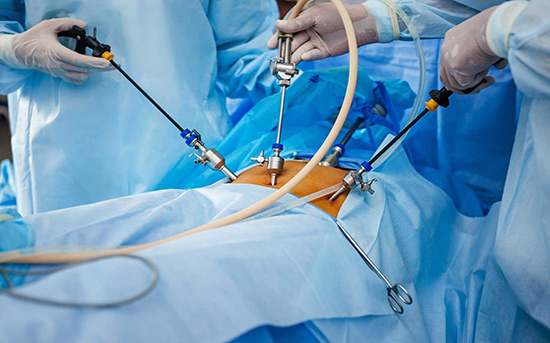
After laparoscopic hernia repair, many patients have less pain and return to light work a little sooner. With both methods, the lifting precautions are similar. The right method for you depends on the type and size of the hernia, whether it is on one or both sides, and your health, and we explain every option before any decision. Hernias at the navel are treated by umbilical hernia repair, and hernias at an old scar by incisional hernia repair, which may need an abdominal belt for some weeks afterwards.
How to prevent the hernia from coming back
A well-done repair, usually with a mesh, holds well in most patients. You can lower the chance of the hernia coming back by keeping a healthy weight, treating long-term cough and constipation, stopping smoking, controlling diabetes and lifting correctly for life. A hernia does not heal on its own with belts or exercises; read more in our article on hernia myths and facts.
When to see a doctor
Please contact us promptly if you have:
- Fever, or redness, warmth or pus at the wound.
- Pain that keeps increasing instead of getting better.
- Swelling that becomes large, hard or very painful.
- Difficulty passing urine, or no urine for many hours.
- Vomiting, a swollen abdomen, or you are not passing gas or stools.
- Pain and swelling in one leg, breathlessness or chest pain.
- A bulge that comes back at the operation site.
At Dr. R.K. Thakur Hospital, Gopalganj, Dr. Rajnish Kumar Thakur, our founder and chief surgeon, performs hernia operations and follows up every patient in our OPD, Monday to Friday, 10 am to 7 pm. Please call or WhatsApp us on +91 72739 94786 to book a follow-up visit or to ask any question during your recovery. Our emergency is open 24 hours.