When to get hydrocele operation done is one of the most common questions men, and parents of baby boys, ask us about a swelling in the scrotum. Some hydroceles can safely be watched, some need surgery, and a few symptoms need a doctor the same day. The right time is different for adults and for children, and needle tapping is not a lasting answer. Knowing how the decision is made, how the operation is done and what recovery involves helps you plan with confidence.
What is a hydrocele?
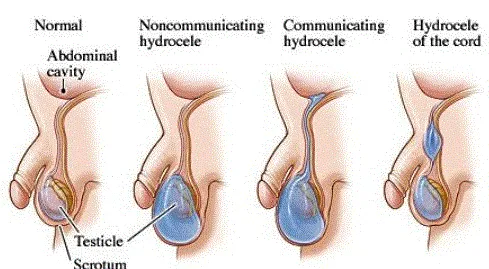
A hydrocele is a collection of fluid in the thin sac around the testis, which makes one or both sides of the scrotum swell. It usually does not hurt. In adults it often has no clear cause, though filaria, injury and infection are known causes in our region. In babies it happens because a small passage between the belly and the scrotum has not closed fully after birth. If you have heard that a hydrocele affects manhood or is caused by bad habits, please read our article on hydrocele myths and facts.
When to get hydrocele operation done in adults
In adults, a hydrocele rarely goes away on its own and tends to grow slowly. Surgery is usually advised when:
- The swelling is large, heavy or dragging
- It rubs or hurts while walking, cycling, farming or sitting for long
- It keeps growing over months
- It causes difficulty during intercourse, trouble with clothes, or embarrassment
- The skin over it becomes sore or infected
- A hernia is also present (see hernia repair), or the cause of the swelling is not clear
When waiting is reasonable: a small, soft hydrocele that causes no trouble and is not growing can often be watched. Please see us again if it grows or starts to bother you. After surgery on a very large, long-standing hydrocele there can be more swelling, which is one reason we advise not waiting until it becomes very large.
Hydrocele in children: wait or operate?
Hydrocele in children is common, especially in newborn boys, and the advice is different from adults:
- In babies, many hydroceles settle on their own by about 1 to 2 years of age, as the passage closes. We usually advise watching.
- Surgery is considered if the hydrocele is still present after about 1 to 2 years, if it gets bigger and smaller during the day (a sign that the passage is still open), or if a hernia is also present.
- The operation in children is different: it is a small operation through the groin, done under general anaesthesia, to close the open passage.
A groin swelling in a child that becomes hard, painful or will not go back, with crying or vomiting, may be a stuck hernia. That is an emergency. You can read more on our page on children's surgery.
Why needle tapping is not a lasting answer
Drawing the fluid out with a needle (tapping) makes the swelling go down for a while. But the sac that makes the fluid is still there, so in most cases the fluid comes back within weeks or months. Repeated tapping carries a risk of infection and bleeding inside the scrotum, and scarring can make a later operation harder. Tapping may be used for a patient who is not fit for surgery, but for most men it is not a cure.
Why an ultrasound comes first
Before deciding, we examine the swelling and usually advise an ultrasound of the scrotum, which is available in our hospital. It confirms that the swelling is fluid, checks the testis underneath and looks for a hernia. This matters because, rarely, a hydrocele can appear along with a problem in the testis itself. We also do blood tests and a fitness check before surgery.
How the hydrocele operation is done
- Anaesthesia: in adults, usually spinal or local anaesthesia (the area is made numb); in children, general anaesthesia.
- A small cut is made on the scrotum and the fluid is drained.
- The sac is turned inside out and stitched behind the testis (eversion), or the extra sac is removed (excision), so that fluid does not collect again.
- Bleeding is carefully controlled, a small drain is sometimes placed, and the cut is closed with stitches.
- A dressing and scrotal support are applied.
The operation usually takes 30 to 60 minutes, and most patients go home the same day or the next day. You can learn more on our page on hydrocele surgery.
Hydrocele operation recovery time
For adults
- Swelling of the scrotum is normal for 1 to 2 weeks and can take a few weeks to settle fully.
- Wear a scrotal support or firm, well-fitting underwear for about 2 to 3 weeks.
- Walking is encouraged from the next day. Keep the wound clean and dry, and follow the bathing advice we give you.
- Light work can usually start in about a week.
- Avoid heavy lifting, cycling and sexual activity for about 2 to 4 weeks, or as our surgeon advises.
For children
Children usually recover quickly, and most go back to school within a few days to a week. Keep them away from rough play, cycling and climbing for a few weeks, as our surgeon advises.
Possible risks
Like any operation, hydrocele surgery has some risks: a collection of blood in the scrotum (haematoma), infection, swelling that lasts longer than usual and, uncommonly, the hydrocele coming back. Injury to the testis or its tubes is rare. The operation is done around the testis, not on it, and usually does not affect erections or the ability to father children. Our surgeon explains the risks for your case before you agree.
Costs and the Ayushman card
Costs depend on the tests needed, the type of anaesthesia, the length of stay and the room type, and we explain them before admission. Our hospital is empanelled under Ayushman Bharat PM-JAY for general surgery packages, and hydrocele surgery is among them. Please bring your Ayushman card and Aadhaar, and our Ayushman help desk will confirm eligibility for your case.
When to see a doctor
- Any new swelling in the scrotum, so that the cause is confirmed
- A swelling that is growing or making walking or work uncomfortable
- Sudden severe pain in a testis, with or without swelling. This can be twisting of the testis (torsion) and needs emergency care within hours.
- A groin or scrotal swelling in a child that becomes hard or painful, or comes with vomiting
- After surgery: swelling or pain that keeps increasing, fever, or pus from the wound
There is no need to feel shy. At Dr. R.K. Thakur Hospital, Gopalganj, hydrocele surgery for adults and children is performed by Dr. Rajnish Kumar Thakur, our founder and chief surgeon. Dr. Thakur is a Laparoscopic, Laser, Urology and General Surgeon with 16+ years of experience. We examine every patient in private, and our emergency care is open 24 hours. Patients come to us from Gopalganj, Siwan, Chhapra, Motihari, Bettiah and nearby Uttar Pradesh. Please call or WhatsApp us on +91 72739 94786 to book your OPD visit.