Hysterectomy means an operation to remove the uterus (womb). For the right reason, it can end years of heavy bleeding, pain or discomfort. But it is also a big and permanent decision: once the uterus is removed, periods stop and a woman cannot become pregnant. So when is hysterectomy needed, and when can other treatment be tried first? Our surgical team answers these questions below.
At our hospital, we explain every option before any decision. The final decision should always be made after a proper examination, tests and an open discussion with your doctor.
Common reasons for hysterectomy
Fibroids
Fibroids are non-cancerous lumps of muscle in the wall of the uterus. Many women have them without any trouble, and small fibroids without symptoms usually need only watching. Treatment is considered when fibroids cause heavy bleeding, anaemia, pain, pressure on the bladder or bowel, or grow quickly.
Heavy or irregular bleeding
Heavy periods, bleeding between periods or bleeding that does not stop can lead to weakness and severe anaemia (low blood). The cause must be found first, with an ultrasound, blood tests and sometimes a sample from the lining of the uterus.
Prolapse (uterus coming down)
After many deliveries, heavy work and ageing, the supports of the uterus can weaken, and the uterus slips down into or out of the vagina. Women feel heaviness, something coming out, or difficulty in passing urine or stool.
Adenomyosis
In adenomyosis, the lining of the uterus grows into its muscle wall. This causes painful, heavy periods and a bulky uterus. It is often treated with medicines first.
Cancer or pre-cancer
Cancer of the uterus, cervix or ovaries, or some pre-cancer changes, may need hysterectomy as part of treatment. These cases are planned carefully with a cancer specialist.
Try alternatives first, where suitable
Many women can be treated without removing the uterus, especially younger women or those who may want more children. Depending on the cause, options include:
- Medicines to reduce bleeding and pain, and iron to correct anaemia
- Hormonal treatment, such as tablets, injections or a hormone-releasing device placed inside the uterus to reduce heavy bleeding
- Removing only the fibroid (myomectomy) and keeping the uterus, in suitable cases
- Pelvic floor exercises, and in some women a ring pessary placed in the vagina, for mild prolapse
- Watchful waiting for mild symptoms close to menopause, since fibroids often shrink after periods stop
An ovarian cyst also does not usually need removal of the uterus; often only the cyst is removed and the ovary is kept (laparoscopic ovarian cyst surgery).
Do not remove the uterus without a clear reason
A hysterectomy should not be done only for mild white discharge, mild back pain, small fibroids without symptoms, or as a routine step because the family is complete. Before agreeing, make sure you understand:
- What exactly is the problem, and what do the reports show?
- Have other treatments been tried or considered?
- What will happen if you wait?
- Will the ovaries be removed or kept?
- Which type of operation is planned, and why?
If you are unsure, it is completely reasonable to ask for a second opinion.
The ovaries decision
The ovaries make hormones that protect a woman's bones and heart. In a woman who has not reached menopause, healthy ovaries are usually kept, because removing them causes sudden menopause, with hot flushes and, over the years, a higher risk of weak bones and heart disease. After menopause, or when there is a problem in the ovaries, removal may be advised. Discuss this clearly with your surgeon, and make sure the decision is written in your consent form.
Types of hysterectomy
Laparoscopic hysterectomy
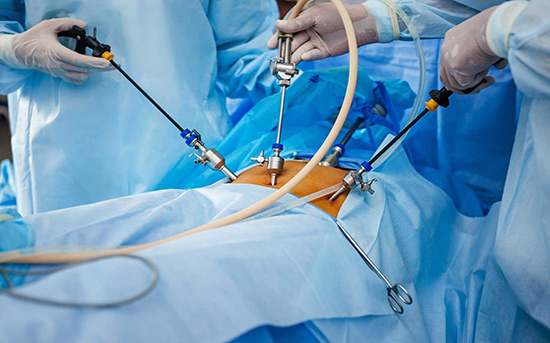
Done through a few small cuts on the belly using a camera and fine instruments (keyhole surgery). There is usually less pain than open surgery, a shorter hospital stay and a quicker return to daily work. Read more about laparoscopic hysterectomy.
Vaginal hysterectomy
The uterus is removed through the vagina, with no cut on the belly. It is often chosen for prolapse, together with repair of the weakened supports (pelvic floor repair). See vaginal hysterectomy with pelvic floor repair.
Open (abdominal) hysterectomy
Done through a larger cut on the lower belly. It may be needed for a very large uterus, some cancers, or when earlier operations have caused heavy scarring inside. Recovery takes longer.
Our surgeon chooses the method based on the size of the uterus, the cause, previous operations and your general health.
Recovery
- The hospital stay is usually about 1 to 3 days after laparoscopic or vaginal surgery, and a few days more after open surgery, as our surgeon decides.
- Start walking early, as advised. It helps prevent clots and gas.
- Avoid lifting heavy weights, such as buckets of water, for about 6 weeks.
- Avoid intercourse for about 6 weeks, or as advised.
- Light spotting for a few weeks is common. Report heavy bleeding, fever or foul discharge.
Privacy and a female attendant
Many women delay treatment out of shyness. At our hospital, you have the right to privacy during examination, and you can ask for a female staff member to be present during any internal examination. You are also welcome to bring a woman from your family as your attendant for the visit and the hospital stay.
When to see a doctor
- Periods so heavy that you soak a pad every hour or two, or pass large clots
- Weakness, dizziness or breathlessness, which can be signs of anaemia
- Any bleeding after menopause
- Bleeding after intercourse or between periods
- A feeling of something coming out of the vagina
- A lump in the lower belly, or severe pain in the pelvis
Women from Gopalganj, Siwan, Chhapra and nearby districts can consult Dr. Rajnish Kumar Thakur, our founder and chief surgeon, at Dr. R.K. Thakur Hospital to understand whether a hysterectomy is really needed or whether other treatment can be tried first. You can read more about our laparoscopic hysterectomy.
In our hospital in Gopalganj, we perform operations such as laparoscopic hysterectomy, vaginal hysterectomy with pelvic floor repair and ovarian cyst surgery, and ultrasound and laboratory tests are available under one roof. To book an OPD visit, please call or WhatsApp us on +91 72739 94786.