Stomach pain is common, and most of it settles on its own. But some stomach pain is a warning of appendicitis, which needs treatment within hours, not days. Knowing the common appendicitis symptoms helps your family act in time. A common mistake is to take painkillers at home and wait, which can let the problem become more serious. Below, our surgical team sets out the warning signs of appendicitis, what to do, and what not to do.
What is appendicitis?
The appendix is a small, finger-shaped tube attached to the large intestine, in the lower right part of the abdomen. Appendicitis means the appendix has become swollen and infected, often because its opening gets blocked.
If it is not treated, the swollen appendix can burst (perforate). Infection then spreads inside the abdomen, causing peritonitis or a pus collection (abscess). A burst appendix is more dangerous and usually needs a bigger operation and a longer hospital stay.
Appendicitis can happen at any age, but it is most common in children, teenagers and young adults.
Classic warning signs
- Pain that starts around the navel and, over a few hours, moves to the lower right side of the abdomen.
- Pain that becomes steady and gets worse with walking, coughing, sneezing or bumps in a vehicle.
- Loss of appetite. Many patients do not feel like eating at all.
- Nausea or vomiting, usually after the pain starts.
- Mild fever, which may rise if the appendix bursts.
- Sometimes constipation, loose motions or a frequent urge to pass urine.
Not everyone has all these signs. The position of the appendix differs from person to person, so pain may be felt in the back, low in the pelvis or higher up.
Signs that the appendix may have burst
- Pain spreading over the whole abdomen.
- A hard, tight belly that hurts to touch.
- High fever, fast heartbeat, or feeling very weak or drowsy.
- Sometimes the pain eases for a short time after bursting and then becomes worse. Do not take this short relief as a sign of cure.
Do not take painkillers and wait
When stomach pain starts, many people take a painkiller tablet or injection from the nearest medical shop and wait for the pain to go. This can hide the pain for a while, but the swelling inside keeps getting worse. By the time the pain returns, the appendix may have burst.
If you suspect appendicitis:
- Do not keep taking painkillers to suppress the pain without a doctor's advice.
- Do not take laxatives or an enema.
- Do not eat a heavy meal. Take only small sips of water until a doctor sees you, because an operation may be needed.
- Do go to a hospital with a surgeon the same day, and carry any old reports.
Children, pregnant women and elderly people
Children
Young children often cannot explain where it hurts. Watch for a child who refuses food, vomits, has fever, lies very still, walks bent forward, or cries when the belly is touched or the vehicle jolts. In young children appendicitis is harder to recognise and is more often found late, after it has burst, so do not wait.
Pregnant women
Appendicitis can happen during pregnancy. As the womb grows, the appendix is pushed upward, so the pain may be felt higher on the right side. Nausea may be mistaken for normal pregnancy sickness. Delay is risky for both mother and baby. A pregnant woman with new, continuous pain on the right side of the abdomen should be examined by a doctor the same day.
Elderly people
Older people may have milder pain and little fever even when the problem is serious. Any unusual or continuing stomach pain in an elderly person should be checked.
In women, problems such as an ovarian cyst or an ectopic pregnancy (a pregnancy outside the womb) can cause similar pain. This is one more reason to get checked quickly rather than guess.
How appendicitis is diagnosed
- Examination of the abdomen by a surgeon.
- Blood tests to look for signs of infection.
- A urine test to rule out urine infection or a kidney stone.
- Ultrasound of the abdomen. In some cases a CT scan may also be advised.
- A pregnancy test in women of child-bearing age, when needed.
Treatment
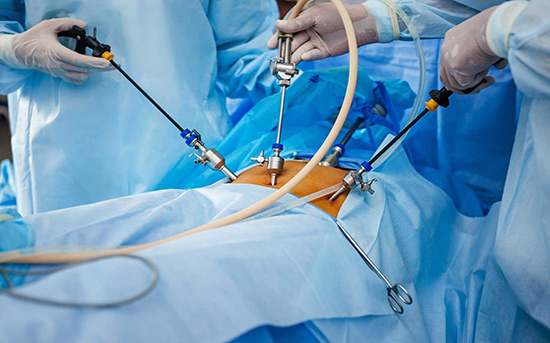
The usual treatment is an operation to remove the appendix, called appendectomy. In most patients it is done by laparoscopic appendectomy through small cuts. If the appendix has burst or there is a large pus collection, open surgery or wider abdominal surgery may be needed. In some carefully selected cases doctors may try antibiotics first, but the problem can come back, and our surgeon will decide what is safest for you.
After a straightforward laparoscopic appendectomy, most patients go home in 1 to 2 days, depending on their condition. Our guide on recovery after laparoscopic surgery explains what to expect at home.
When to see a doctor
Go to a hospital emergency straight away if:
- Stomach pain has lasted more than a few hours and is moving to, or staying in, the lower right side.
- The pain comes with fever, vomiting or loss of appetite.
- The pain gets worse on walking, coughing or in a moving vehicle.
- The belly is hard, swollen or very tender.
- A child, a pregnant woman or an elderly person has unexplained, continuing stomach pain.
At Dr. R.K. Thakur Hospital, we examine patients from Gopalganj, Siwan, Chhapra and nearby districts, including the bordering districts of Uttar Pradesh, who come with stomach pain that could be appendicitis. When the diagnosis is confirmed, our surgeons usually remove the appendix by keyhole surgery. You can read more about our laparoscopic appendix surgery.
Our 24x7 emergency in Gopalganj is supported by ultrasound, a pathology laboratory, modern operation theatres and an ICU. Our surgical team is led by Dr. Rajnish Kumar Thakur, our founder and chief surgeon, who has 16+ years of experience in laparoscopic and general surgery. Please call us on +91 72739 94786 while you are on the way, so that our team is ready to receive you. For a planned OPD visit, please see our contact page.