Appendix operation recovery time is usually short, especially after keyhole surgery: most people are home in 1 to 2 days and back to school or light work in 1 to 2 weeks. Recovery is slower if the appendix had burst. Below, our surgical team explains what to expect day by day, what to eat after the operation, how laparoscopic and open surgery differ, and the warning signs that need a doctor straight away.
Why the appendix is removed
The appendix is a small, finger-shaped tube attached to the large intestine on the lower right side of the belly. When it gets blocked and infected (appendicitis), it can swell and burst, spreading infection inside the abdomen. That is why appendicitis is treated as an emergency and the appendix is usually removed, an operation called appendectomy. Living without an appendix causes no known major health problems, and no special lifelong diet is needed. Read about the early signs in our article on appendicitis warning signs.
Appendix operation recovery time at a glance
These are typical times after an uncomplicated laparoscopic operation. Our surgeon adjusts them for each patient.
- Walking: the same day or the next morning
- Hospital stay: usually 1 to 2 days; 3 to 5 days or more if the appendix had burst
- Food: sips of water and liquids first, then light food, usually within the first day
- School, office or light work: usually in 1 to 2 weeks
- Heavy lifting, farm work, sports and gym: usually after about 4 weeks
- Driving a car or motorcycle: once you can turn and brake without pain and no longer need strong pain medicines
Laparoscopic vs open appendix surgery
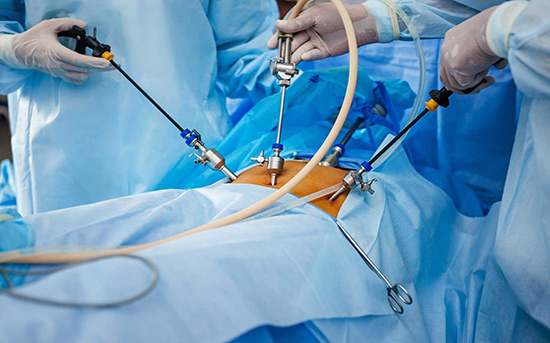
In laparoscopic surgery (doorbeen se operation), the surgeon makes 3 small cuts, usually near the navel and on the lower belly, and removes the appendix while watching on a screen. Because the cuts are small, most patients have less pain, walk sooner and return to routine sooner than after open surgery.
In open surgery, the appendix is removed through one larger cut on the lower right side of the belly. It may be chosen, or a laparoscopic operation may be changed to open, when the appendix has burst with a large amount of pus, when there is a lump of inflamed tissue, or when laparoscopy is not safe for that patient. Recovery usually takes a few days longer, and heavy work is often avoided for about 4 to 6 weeks.
If a burst appendix has spread infection widely, a bigger emergency operation on the abdomen may be needed; see emergency abdominal surgery. Our surgeon will explain which approach is safest for you. You can learn more on our page on laparoscopic appendix surgery.
What to eat after appendix operation
The intestine slows down for a short time after any abdominal operation, so food is restarted step by step. Please follow our team's advice on when to begin.
First day: liquids
Start with sips of water. If there is no vomiting, move to clear liquids such as coconut water, thin dal water, clear soup, ORS or weak tea with little sugar. After a burst appendix, food may be started more slowly.
Days 2 to 7: soft, light food
- Khichdi, dal and rice, curd rice, daliya or suji upma
- Boiled potato, idli, and soft roti with light vegetables such as lauki or tori
- Banana, papaya and stewed apple
- Curd or buttermilk, if they suit you
- Small meals 5 to 6 times a day rather than 2 large ones
After the first week: back to normal home food
Move gradually back to your usual diet. Include green vegetables, fruits and whole grains to prevent constipation, and protein such as dal, eggs, paneer, fish or chicken to help the wounds heal. Drink enough water through the day.
What to avoid for 1 to 2 weeks
- Very spicy, oily and fried food
- Heavy meat gravies and street food
- Aerated cold drinks, which can cause gas and bloating
- Alcohol, and smoking or tobacco, which slow healing
Some people have constipation or loose stools for a few days after surgery. Water, fibre and walking usually help. If constipation lasts more than 2 to 3 days, please ask us for a mild laxative rather than straining. If you have diabetes, keep your sugar under control, as high sugar slows wound healing.
Wound care and bathing
- Keep the wounds clean and dry until our team says you can bathe, then pat them dry gently.
- Do not apply oil, powder, turmeric or home pastes on the wounds.
- Mild pain around the cuts, and pain at the tip of the shoulder for a day or two after laparoscopy, are common.
- Please come for the stitch check on the date we give you.
Returning to school, work and daily life
Most children return to school, and most adults to office or shop work, within 1 to 2 weeks after laparoscopic surgery. Walking a little several times a day helps recovery from day one. Avoid heavy lifting, farm work, sports and long cycle rides for about 4 weeks after laparoscopic surgery, and longer after open surgery or a burst appendix, as advised. For general tips on healing after keyhole surgery, see our guide on recovery after laparoscopic surgery.
The histopathology report
The removed appendix is sent to a laboratory to be examined under a microscope. The report usually confirms appendicitis. Rarely it shows another condition that needs follow-up, so please collect the report from us at your follow-up visit.
Costs and the Ayushman card
Costs depend on whether the surgery is laparoscopic or open, whether the appendix had burst, the tests needed and the length of stay, and we explain them clearly to the family. At Dr. R.K. Thakur Hospital, our Ayushman Bharat PM-JAY empanelment covers general and laparoscopic surgery packages, and appendix surgery is among them. Our Ayushman help desk confirms eligibility for each patient.
When to see a doctor: warning signs after appendix surgery
Please come back to us straight away, day or night, if you notice:
- Fever, especially with shivering
- Belly pain that is getting worse instead of better, or a belly that is swelling up
- Repeated vomiting, or not being able to keep liquids down
- Redness, swelling, pus or a bad smell from a wound
- No stool or gas for more than 2 to 3 days, with bloating
- Breathlessness, chest pain, or a painful swollen leg
At Dr. R.K. Thakur Hospital, Gopalganj, appendix surgery is performed by Dr. Rajnish Kumar Thakur, our founder and chief surgeon, a Laparoscopic, Laser, Urology and General Surgeon with 16+ years of experience. Anaesthesia is given by our anaesthesia specialist. Our emergency is open 24 hours, and ultrasound, pathology and an ICU are available within our hospital. Families come to us from Gopalganj, Siwan, Chhapra, Motihari, Bettiah and nearby Uttar Pradesh. Please call or WhatsApp us on +91 72739 94786 for advice or to book a follow-up visit.