A hernia is a common problem in men, women and children. Many people in Gopalganj and nearby villages live with a swelling in the groin or near the navel for years, hoping it will go away with a belt, massage or medicine, and many search for ways to treat a hernia without surgery. Here, our surgical team explains honestly what can and cannot help a hernia, which danger signs need emergency care, and why waiting too long can make surgery harder.
What is a hernia?
The muscles of the abdominal wall hold the intestines and fat inside. When there is a weak spot or gap in these muscles, some of the tissue inside pushes out through it and forms a soft swelling under the skin. That swelling is a hernia.
Common types are:
- Inguinal hernia: in the groin, sometimes going down into the scrotum in men. This is the most common type.
- Umbilical hernia: at or near the navel.
- Incisional hernia: through the scar of an old operation, such as a caesarean or other abdominal surgery.
- Epigastric hernia: in the middle of the upper abdomen, between the navel and the chest.
A hernia often looks bigger when you stand, cough or lift something, and smaller or flat when you lie down.
Can a hernia heal without surgery?
In adults, the honest answer is no. A hernia is a gap in the muscle wall. No medicine, exercise, oil massage, yoga posture or herbal remedy can close that gap. Over time, hernias usually get bigger, not smaller.
There is one common exception. Small umbilical hernias in babies often close on their own during the first few years of life. A doctor will check the child and advise if and when surgery is needed.
This does not mean every adult hernia needs an operation the very next day. For a small hernia that causes no pain, especially in an elderly person with other illnesses, the surgeon may sometimes advise careful waiting with regular check-ups. Many such patients still need surgery later, so this decision should be made by a surgeon.
Do hernia belts and trusses help?
A hernia belt or truss presses on the hernia to keep it pushed in. It can give comfort to some people, for example while waiting for surgery or when a person is not fit for an operation. But it has clear limits:
- A belt does not close the gap. When you remove it, the hernia comes back.
- A poorly fitting belt can rub the skin and cause pain or sores.
- A belt should never be used on a hernia that cannot be pushed back in.
- A belt can make people ignore a hernia that is slowly getting worse.
Use a belt only if your surgeon advises it, and keep your follow-up visits.
Danger signs: when a hernia becomes an emergency
Sometimes the intestine or fat gets trapped in the hernia and cannot go back. This is called an obstructed or incarcerated hernia. If the blood supply to the trapped intestine is cut off, it is called a strangulated hernia. Strangulation is an emergency, because the trapped intestine can be badly damaged within hours.
Come to the emergency immediately if:
- The hernia suddenly becomes painful, hard or tender.
- It cannot be pushed back in, when earlier it could.
- The skin over it turns red, purple or dark.
- You have vomiting, a swollen belly, or you are not passing stool or gas.
- You have fever or feel very unwell along with hernia pain.
Do not try to push a painful, hard hernia back with force, and do not wait for it to settle with painkillers. At Dr. R.K. Thakur Hospital, our 24x7 emergency is supported by operation theatres and an ICU.
Why delaying surgery can make it harder
- The hernia grows. A larger hernia needs a bigger repair and a longer recovery.
- Emergency surgery carries more risk. A planned operation is done after tests, when you are prepared. An emergency operation for a strangulated hernia may need removal of damaged intestine and a longer hospital stay.
- Keyhole repair may no longer be suitable. Very large or long-standing hernias sometimes need open surgery.
- Daily life suffers. A growing hernia can make farm work, lifting and even walking uncomfortable.
Other common myths about hernia
Myth: hernia happens only from lifting heavy weight
Lifting can make a hernia appear or grow, but a weak spot is often already there. Long-standing cough, constipation, straining to pass urine (for example due to prostate enlargement), obesity, pregnancy and old operation scars all add pressure.
Myth: after hernia surgery you can never do heavy work
Most people return to their normal work, including farming and labour, after a period of healing. Your surgeon will tell you when it is safe to lift heavy weight again.
Myth: a hernia always comes back after surgery
A hernia can come back after repair, but this is not common after a good repair. Surgeons often use a mesh, a soft sterile net, to strengthen the weak area. Treating cough and constipation and following lifting advice also help.
Treatment options
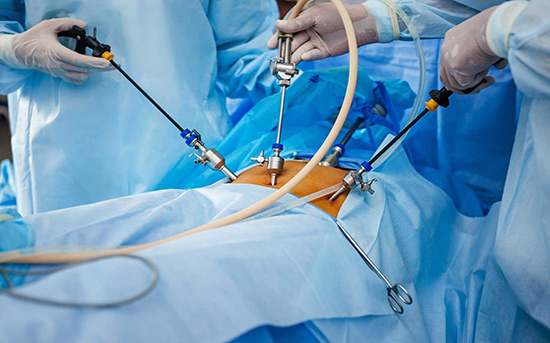
Our surgeon will choose between laparoscopic hernia repair and open repair based on the type and size of the hernia, your health and any previous operations. Specific repairs are also done for umbilical hernia and incisional hernia. To understand the two approaches, read laparoscopic vs open surgery.
When to see a doctor
- You notice a new swelling in the groin, near the navel or at an old operation scar.
- Your hernia is getting bigger or causing pain or heaviness.
- You are using a belt and are unsure whether it is safe.
- Your child has a swelling in the groin. Groin hernias in children do not close on their own and need a surgeon's review.
- You have any of the danger signs above. Go to the emergency immediately.
At Dr. R.K. Thakur Hospital, we examine patients from Gopalganj, Siwan, Chhapra and nearby districts and tell them honestly whether their hernia needs an operation now or can be watched for a while. You can read more about our laparoscopic hernia repair.
Dr. Rajnish Kumar Thakur, our founder and chief surgeon, a general and laparoscopic surgeon with 16+ years of experience, sees hernia patients in our OPD in Gopalganj. Please call or WhatsApp us on +91 72739 94786 to book a visit, and bring any old operation papers with you. Ayushman Bharat card holders are welcome to ask our help desk about coverage.