Prostate Surgery (TURP)
TURP relieves urine problems caused by an enlarged prostate in older men. Our surgeon trims the blocking prostate tissue from inside, through the urinary passage, with no cut on the body.
We diagnose and treat a narrowed urinary passage (urethral stricture) and a tight bladder neck, using cystoscopy, VIU and BNI done through the urinary passage without a cut on the body.
If your urine stream has become thin or weak, or you have to strain to pass urine, we offer urethral stricture treatment in Gopalganj at Dr. R.K. Thakur Hospital. A urethral stricture is a narrowing of the urinary passage, and a tight bladder neck is a blockage at the outlet of the bladder. We check and treat both through the urinary passage, without a cut on the body. Weak urine stream treatment starts with the right tests: a urine test, an ultrasound and, when needed, a cystoscopy test in Gopalganj itself. Our urology services are led by Dr. Rajnish Kumar Thakur (MBBS, MS General Surgery), our founder and chief surgeon, and our Senior Consultant Laparoscopic, Laser, Urology and General Surgeon. Patients come to us from Gopalganj, Siwan, Chhapra, Motihari, Bettiah, Kushinagar and Deoria. They trust Dr. Thakur for his 16+ years of surgical experience and his work at IGIMS Patna and Lady Hardinge Medical College. Please visit our OPD, Monday to Friday, 10 am to 7 pm, or WhatsApp your reports to +91 72739 94786.
Urine flows out of the bladder through the bladder neck and then through the urethra (the urinary passage). If this path becomes narrow, urine cannot flow freely. A urethral stricture is a narrowing of the urinary passage caused by scar tissue, often after an injury, an old infection, or a catheter or instrument used in the past. A bladder neck problem is a tight opening at the base of the bladder, sometimes seen after earlier prostate surgery or in men whose prostate is not large.
Cystoscopy means looking inside the urinary passage and bladder with a thin telescope that has a camera. VIU (visual internal urethrotomy) uses a fine blade passed through the telescope to cut the scar and open a stricture. BNI (bladder neck incision) makes small cuts in a tight bladder neck to widen it. No cut is made on the body.
We consider these procedures when you have a thin or weak stream, straining, dribbling, repeated urine infections or retention. Tests may include a urine test, an ultrasound to see how much urine stays in the bladder, and a special X-ray of the urinary passage with dye to show where the narrowing is and how long it is. Cystoscopy is also used to find the cause of blood in the urine.
After VIU or BNI, a catheter is kept for some days. It is then removed for a trial of voiding: you drink water and pass urine, and our team checks that the stream is good and the bladder empties well, sometimes with an ultrasound. If you cannot pass urine, we put the catheter back and repeat the trial later.
A stricture can come back. Some patients need a repeat VIU, regular stretching, or a bigger repair called urethroplasty at a higher centre.
Most people walk and eat the same day. Some burning and a little blood in the urine are common for a few days. Look after the catheter as shown, keep the bag below the level of the bladder, and drink plenty of water. After the catheter is removed, pass urine regularly and notice your stream. Please come back to us quickly if the stream becomes thin again, you need to strain, or you cannot pass urine. Follow-up visits are important because a stricture can narrow again, especially in the first few months.
Possible risks include bleeding, urine infection or fever, and temporary burning. A urethral stricture can come back after VIU, sometimes needing repeat treatment or a bigger repair operation. After BNI, some men notice retrograde ejaculation, which means semen goes back into the bladder. Rarely, urine leakage or injury to nearby tissue can happen. We lower these risks by treating infection first, using careful technique and arranging regular follow-up.
The cost of cystoscopy, VIU or BNI depends on what is found and what is done. A simple diagnostic cystoscopy with numbing jelly is usually a short day-care test, while VIU or BNI needs anaesthesia and usually a 1 to 2 day stay. Other factors are the tests (urine culture, ultrasound, kidney function), the type of anaesthesia, how long the catheter stays, the room type, medicines, and whether a repeat procedure or dilatation is needed later. A long or complex stricture may need an open repair (urethroplasty) at a higher centre, which our surgeon will discuss openly with you. After the OPD visit, we give you a clear written estimate before admission, and you are welcome to send reports on WhatsApp first. Ayushman Bharat PM-JAY: as of mid-2025, urology packages such as VIU and BNI were not part of our empanelment, which covered general and laparoscopic surgery packages. Please confirm with our Ayushman help desk.
Our chief surgeon, Dr. Rajnish Kumar Thakur, performs cystoscopy, VIU and BNI as part of his urology work. He has 16+ years of surgical experience and more than 10,000 surgeries performed, with experience at IGIMS Patna and Lady Hardinge Medical College, New Delhi. We have ultrasound, digital X-ray, a pathology laboratory, modern operation theatres and 24x7 emergency care for urinary retention under one roof. Please call us on +91 72739 94786.
A urethral stricture is a narrowing of the urinary passage caused by scar tissue. Common causes include an injury, such as falling astride a hard object, old infections, and previous use of a catheter or instruments in the urinary passage. Sometimes no cause is found. The narrowing makes the stream thin and weak and, if left untreated, can lead to infections or complete blockage.
Cystoscopy is usually more uncomfortable than painful. For a simple check, numbing jelly is put into the urinary passage, and the test takes about 10 to 20 minutes. If treatment is also planned, spinal or general anaesthesia is given. For a day or two afterwards you may feel burning and see pink urine. Drinking water helps. If you get a high fever or cannot pass urine, please come back to us.
After VIU, BNI or prostate surgery, a catheter is kept for some days. A trial of voiding means removing the catheter and checking that you can pass urine well on your own. You drink water and pass urine, and our team checks your stream and may measure the leftover urine with an ultrasound. If you cannot pass urine, we put the catheter back and repeat the trial later.
It can. VIU works well for many short strictures, but some narrow again, especially long or repeated ones. Please watch your stream and come for follow-up visits. If it narrows again, the options include a repeat VIU, regular gentle stretching (dilatation), or a bigger repair operation called urethroplasty, for which we may refer you to a higher centre. Our surgeon explains what suits your case.
Ayushman Bharat PM-JAY coverage at a hospital depends on the specialities it is empanelled for. As of mid-2025, our empanelment covered general and laparoscopic surgery packages, and urology packages such as VIU and BNI were not included. This can change, so please ask our Ayushman help desk for the current status before admission. For patients who are not covered, we explain the costs clearly before admission.
We perform both under spinal or general anaesthesia through the urinary passage, with no cut on the body. In VIU (visual internal urethrotomy), a thin telescope is passed up to the narrowing and a fine blade cuts the scar to open the passage. In BNI (bladder neck incision), the tight bladder outlet is cut in the same way. Each usually takes 20 to 45 minutes, and a catheter then stays for some days.
Most people walk and eat the same day and go home in 1 to 2 days, usually with a catheter for some days. Burning and a little blood in the urine are common for a few days. Drink plenty of water, avoid constipation, and avoid heavy lifting and cycling until our doctor allows. After the catheter comes out, watch your stream daily and keep every follow-up visit, especially in the first few months.
A weak stream is a symptom, not a disease, so treatment depends on the cause. In older men it is often an enlarged prostate. In younger men, a stricture from an old injury or infection is common. A tight bladder neck, a weak bladder from diabetes, or a stone can also cause it. A urine test, an ultrasound with a check of leftover urine and, if needed, a cystoscopy help us find the cause before treatment.
Cystoscopy is a look inside the urinary passage and bladder with a thin telescope. A simple check is often done with numbing jelly as day-care, while treatment such as VIU needs anaesthesia and a short stay. The cost depends on the type of procedure, the anaesthesia, tests, the stay, the room type and medicines. We do not quote a price without seeing your case. We give you a clear written estimate before admission.
Medicines cannot open a narrowing caused by scar tissue. Some short strictures are managed by gentle stretching with thin instruments (dilatation), which may need to be repeated. VIU is a small procedure done from inside, without a cut on the body. Long or repeated strictures may need an open repair called urethroplasty at a higher centre. If you cannot pass urine at all, please come to our emergency so the bladder can be drained.
Yes. Patients from Motihari, Bettiah, Siwan, Chhapra, Kushinagar and Deoria come to us for cystoscopy, VIU and BNI. Please send your reports and any old operation papers on WhatsApp to +91 72739 94786 first. Tell us about any past catheter, injury or urine infection, as these help us plan the treatment. If urine stops completely, go to the nearest emergency or come to our 24-hour emergency without delay.
People often ask us this. Our urology services are led by Dr. Rajnish Kumar Thakur, our founder and chief surgeon, a general and laparoscopic surgeon (MS General Surgery) with a urology practice. He has 16+ years of surgical experience and more than 10,000 surgeries performed, and has worked at IGIMS Patna and Lady Hardinge Medical College, New Delhi. Families across the region trust him for cystoscopy, VIU, BNI and TURP, and he refers complex strictures for urethroplasty when needed. You can read our patients' reviews on our reviews page.
Share your details and our team will call you back to plan your visit.
This information is for general awareness and does not replace a consultation. Treatment depends on each patient's condition.
Last updated: 30 September 2026
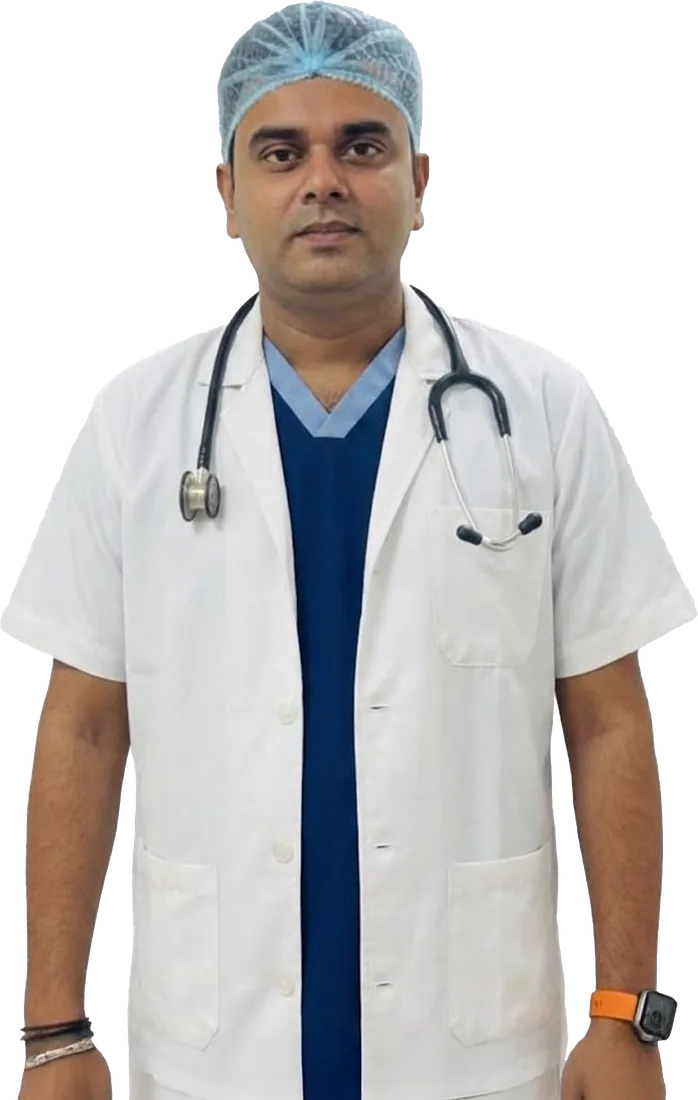
Founder and Chief Surgeon: Laparoscopic, Laser, Urology and General Surgeon
MBBS, DA, MS (General Surgery)
View detailsReal reviews from patients and families, as posted on our Google Business Profile.

I Recently Visited this Clinic in Gopalganj, Earlier I was a bit Hesitant, But Once I met the Doctor, I was so Sure & Confident that I am in Good Hands,
Very Well Experienced Doctor
Well Behaved Staffs
Nice Arrangements
& Most Important, Very Easy Procedure.
Would Always be Thankful to Mr. RK Thakur & His Team.
My relative hernia surgery at Dr RK Thakur Hospital Went Very Well, Skilled Doctors, Caring Staff and Smooth recovery, Highly Satisfied.
डाक्टर साहब बहुत अच्छे है उनका बात करने का अंदाज बहुत ही निराला है स्टाफ के बारे में कुछ नहीं कहा जा सकता बाकी हॉस्पिटल अच्छा हैDoctor sahib is very good, and the way he talks to patients is truly special. I cannot say much about the staff, but otherwise the hospital is good.
Share your name and phone number. Our team will call you back to plan your OPD visit.
