Lump and Cyst Removal
We remove lumps under the skin, such as sebaceous cysts, dermoid cysts and neurofibromas, and send the tissue for histopathology (a biopsy report) to confirm what it is.
We assess a neck swelling or goitre step by step with thyroid blood tests, ultrasound and FNAC, and then give you honest advice on whether medicines, observation or surgery is right for you.
If you have a swelling in the front of the neck, we offer careful thyroid swelling treatment in Gopalganj that always starts with a clear diagnosis. At Dr. R.K. Thakur Hospital, Dr. Rajnish Kumar Thakur, our founder and chief surgeon, MS (General Surgery), examines the neck, arranges thyroid blood tests, a neck ultrasound and, when needed, a thyroid nodule FNAC test, and then advises tablets, regular follow-up or an operation. Most goitres and nodules are not cancer, and many never need an operation, so goitre treatment without surgery is often possible. Patients come to us from Gopalganj and from Siwan, Chhapra, Motihari, Bettiah, Kushinagar and Deoria, because the consultation and tests are available under one roof. Families trust Dr. Thakur for his 16+ years of surgical experience, his work at IGIMS Patna and Lady Hardinge Medical College, New Delhi, and his ethical approach: we advise surgery only when it is truly needed. To consult, please visit our OPD (Monday to Friday, 10 am to 7 pm) or send your thyroid reports on WhatsApp to +91 72739 94786.
The thyroid is a butterfly-shaped gland in the front of the neck. It makes hormones that control the body's energy and metabolism. A swelling of the thyroid is called a goitre. It can be a smooth enlargement of the whole gland, or one or more lumps called nodules.
Most thyroid swellings are not cancer. Some are linked to iodine deficiency, some to the gland working too much (hyperthyroidism) or too little (hypothyroidism), and some are simple nodules or fluid-filled cysts. A few nodules need careful checking to rule out cancer.
Our assessment at Dr. R.K. Thakur Hospital answers three questions: What is the swelling? Is the thyroid working normally? Does it need medicine, observation or surgery? It includes an examination, thyroid blood tests (TSH, T3, T4), a neck ultrasound and, when needed, FNAC (fine needle aspiration cytology), in which a thin needle takes a few cells from the lump for examination under a microscope.
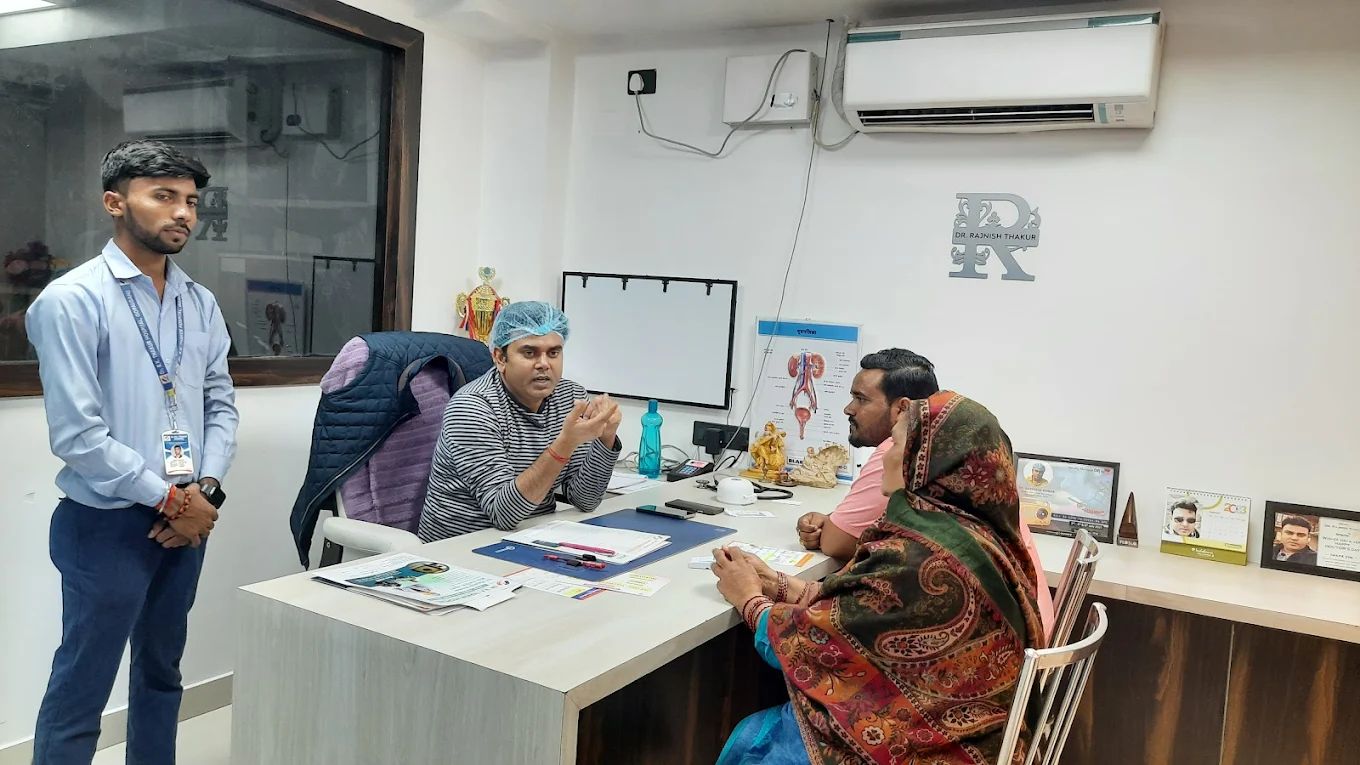
Please get a thyroid check if you notice a neck swelling or signs of thyroid imbalance, such as unexplained weight change, tiredness or palpitations. Please see a doctor quickly if the swelling is growing fast, feels hard or fixed, or comes with a hoarse voice, difficulty swallowing or breathing, or other neck lumps.
Medicine or surgery? Many goitres and nodules need only tablets or regular ultrasound follow-up, and hormone problems are usually treated first with tablets. We generally consider surgery (thyroidectomy: removing part or all of the gland) when a large goitre presses on the windpipe or food pipe, when FNAC shows cancer or a suspicious result, when an overactive thyroid is not controlled with medicines, or when a large swelling troubles the patient.
If we advise surgery, our surgeon explains the operation, its risks and whether it is best done here or at a higher centre for your case.
The assessment itself needs no recovery time. After FNAC, you may feel mild soreness or see a small bruise for a day or two, and you can go home the same day and carry on with normal work. If you start thyroid tablets, take them exactly as advised and repeat the blood tests when your doctor asks. Please do not stop the medicine or change the dose on your own.
Most people go home the same day after the check. These steps help:
Thyroid blood tests and ultrasound carry no significant risk. FNAC is a minor OPD test and may cause mild pain, a small bruise or, rarely, bleeding into the swelling. Sometimes the FNAC result is unclear and the test needs to be repeated. If thyroid surgery is advised later, our surgeon explains its possible risks, such as a change in voice, low calcium and bleeding, in detail before any decision is made.
For most people, a thyroid swelling check is done in our OPD, and the cost depends on what you need:
Recent, reliable old reports may save some repeat tests, so please bring them, or send them on WhatsApp first. If an operation is advised, its cost depends on the type of operation, where it is best done, the days in hospital and the room, and we give you a clear estimate before any admission. Ayushman Bharat PM-JAY is mainly for treatment during a hospital admission. Our hospital is empanelled under PM-JAY for general surgery packages, and if an operation is advised, our Ayushman help desk confirms whether it is covered for you and under which package.
At Dr. R.K. Thakur Hospital, your assessment is led by Dr. Rajnish Kumar Thakur, MS (General Surgery), who has 16+ years of surgical experience and has worked at IGIMS Patna and Lady Hardinge Medical College, New Delhi. Blood tests and neck ultrasound are available in our hospital, saving repeated trips for patients from villages and nearby districts.
Our approach is careful and ethical: we advise surgery only when it is truly needed. For suspected cancer, our visiting surgical oncologist, Dr. (Ex Capt) Feroz Pasha, holds an oncology OPD on the 1st Saturday of every month.
No. Most thyroid swellings and nodules are not cancer. Many are due to iodine deficiency, hormone imbalance, or harmless nodules and cysts. However, some features, such as fast growth, a hard or fixed lump, a hoarse voice or swollen neck glands, need quick checking. Ultrasound and FNAC help tell the difference, so please do not guess or ignore a swelling.
Ghenga is the common name for a goitre, a swelling of the thyroid gland in the front of the neck that moves up when you swallow. Gale ki ganth can mean a thyroid nodule, but it can also be a swollen lymph gland or another kind of lump. That is why every neck lump should be examined, and tests such as ultrasound and FNAC help find the cause.
Our doctor asks about your symptoms and examines your neck. Thyroid blood tests (TSH, T3, T4) and a neck ultrasound follow, and if a nodule needs checking, FNAC is done in the OPD in a few minutes with a thin needle. Most people need 1 to 2 OPD visits. You go home the same day and can work normally, and some reports take a few days.
FNAC means fine needle aspiration cytology. A thin needle, similar to one used for an injection, is passed into the lump to take a few cells. It takes a few minutes in the OPD and usually does not need anaesthesia. Most people feel only mild discomfort. The cells are checked under a microscope to find out whether the lump is harmless or needs treatment.
Often, yes. If the thyroid is underactive or overactive, tablets usually control the problem, and some goitres become smaller or stop growing. Harmless nodules may need only follow-up with ultrasound. We consider surgery for a large goitre causing pressure, a suspicious or cancerous FNAC result, or an overactive thyroid that is not controlled with medicines.
We generally consider surgery when a large goitre presses on the windpipe or food pipe, when the FNAC report shows cancer or is suspicious, when an overactive thyroid is not controlled with tablets, or when a large swelling troubles you. If we advise surgery, our surgeon explains the operation, its risks and whether it is best done at our hospital or at a higher centre for your case.
Please bring all old thyroid blood reports (TSH, T3, T4), any neck ultrasound or FNAC reports, and the names and doses of the medicines you take. Old reports help our doctor see whether the swelling or hormone levels have changed over time. If you are pregnant or planning a pregnancy, please tell us, as thyroid care is especially important then.
Using iodised salt in normal amounts is recommended for most families and helps prevent goitre caused by iodine deficiency. However, if you already have a thyroid problem, especially an overactive thyroid, follow your doctor's advice about diet and supplements. Do not take iodine tablets or home remedies on your own.
Most people with a thyroid swelling do not need a special diet. Eat normal home food and use iodised salt in normal amounts, unless your doctor advises otherwise. Tablets for an underactive thyroid are usually taken on an empty stomach in the morning, with a gap before tea, breakfast, calcium or iron tablets. Never stop or change the dose yourself, and repeat blood tests when asked.
The cost depends on the tests you need: blood tests, a neck ultrasound and FNAC if advised, plus tablets and follow-up tests. If an operation is advised, we explain its estimate before any admission. Ayushman Bharat PM-JAY is mainly for treatment during a hospital admission. Our hospital is empanelled for general surgery packages, and our Ayushman help desk confirms whether an advised operation is covered for you.
Yes. We regularly see patients from Kushinagar, Deoria, Siwan, Chhapra, Motihari and Bettiah. Please send your old thyroid reports and any ultrasound or FNAC report on WhatsApp to +91 72739 94786 first, so our doctor can tell you which tests are still needed. Our OPD runs from Monday to Friday, 10 am to 7 pm. Blood tests and ultrasound can usually be done at our hospital.
We suggest choosing a doctor who checks the swelling properly with blood tests, ultrasound and FNAC before deciding, and who does not push surgery. Dr. Rajnish Kumar Thakur, our founder and chief surgeon, MS (General Surgery), has 16+ years of surgical experience and has worked at IGIMS Patna and Lady Hardinge Medical College, New Delhi. Tests are done at our hospital, and for suspected cancer our visiting surgical oncologist holds a monthly OPD.
Share your details and our team will call you back to plan your visit.
This information is for general awareness and does not replace a consultation. Treatment depends on each patient's condition.
Last updated: 30 September 2026
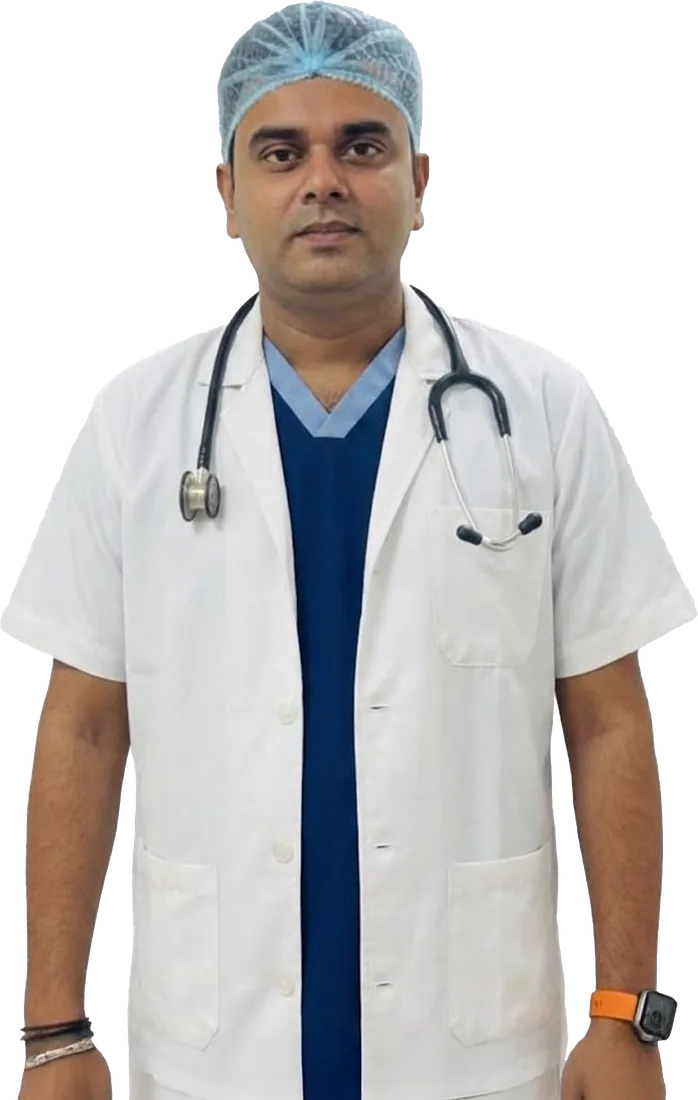
Founder and Chief Surgeon: Laparoscopic, Laser, Urology and General Surgeon
MBBS, DA, MS (General Surgery)
View detailsReal reviews from patients and families, as posted on our Google Business Profile.

I Recently Visited this Clinic in Gopalganj, Earlier I was a bit Hesitant, But Once I met the Doctor, I was so Sure & Confident that I am in Good Hands,
Very Well Experienced Doctor
Well Behaved Staffs
Nice Arrangements
& Most Important, Very Easy Procedure.
Would Always be Thankful to Mr. RK Thakur & His Team.
My relative hernia surgery at Dr RK Thakur Hospital Went Very Well, Skilled Doctors, Caring Staff and Smooth recovery, Highly Satisfied.
डाक्टर साहब बहुत अच्छे है उनका बात करने का अंदाज बहुत ही निराला है स्टाफ के बारे में कुछ नहीं कहा जा सकता बाकी हॉस्पिटल अच्छा हैDoctor sahib is very good, and the way he talks to patients is truly special. I cannot say much about the staff, but otherwise the hospital is good.
Share your name and phone number. Our team will call you back to plan your OPD visit.
